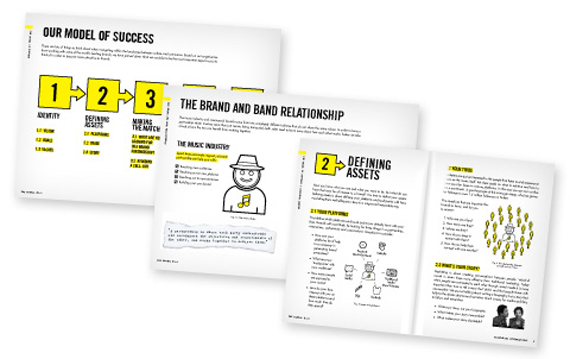
Heartbeats gives you ‘The Manual’ – a manual for bands and artists on how to build a successful strategy to attract brands (or how to sell out without selling out). This material was first presented at MIDEM earlier this year, and due to a big interest from artists, record labels and publishers, in getting access to the material, Heartbeats decided to put together ‘The Manual’.
Today marketers speak of turning customers into fans of brands as the thing to do, to build loyalty and reach communication goals. But nobody has really explained why it’s more beneficial for a brand to have fans, rather than customers, or how turning a customer into a fan is done in practice. Sara Zaric at Heartbeats International gives it a shot…
Today, a customer may be anyone from a purchaser to a speculator of a product or service. In fact, the word customer is also used to describe a ‘viewer’ of a product or service, with no intention to buy or speculate at all. A fan, on the other hand, is most often referred to as a person with a sincerely strong interest, devotion and enthusiasm for a certain person or object. The difference between the two, in itself, gives us a clue to the preferable choice, doesn’t it? Who doesn’t want people to be enthusiastic over ones products or services? I know I would! However, I’ll try to dig a little bit deeper into the benefits of having fans, rather than customers, and I’ll also let you know how you can turn customers into fans of your brand.
In today’s market space (yes, I call it a space, since it’s not a literal place anymore), customers need to be lured to buy a certain product or service, while fans in contrast, come on their own. Why? Because they feel a huge enthusiasm and liking for the object of their interest. Simply put, fans are emotionally attached. So, while customers (only) give their money, fans give their whole hearts, and they show this through their engagement; by promoting and spreading the word about the object of their liking and affection, in real life and on social media platforms.
Further, customers frequently seek out the lowest prices, and they have no trouble with altering supplier if they find a product or service cheaper than the one your brand offers (sometimes even setting aside quality). But this would never happen if you had fans. Why? Well, fans are not interested in things based on prices. Fans seek experiences, (almost) no matter what the cost. Thus, customers easily leave, while fans stay loyal. So having fans rather than customers will certainly make your brand more successful.
But, what can you do to turn your customers into fans of your brand? First of all, fans can’t be bought. Their affection needs to be earned. Simply put, you have to win your fans, just as artists and other performers win theirs. And to do that, you have to connect emotionally with your customers, making them feel for your brand. How is this done, you might ask? My answer is, by offering your customers something of value, something authentic and real that communicates your brand. Music, for example…
Ranked as the media most people would least like to live without, music creates emotions, experiences, engagement, and it makes it possible for your brand to acquire an exclusive position in the mind of your customers. So what are you waiting for? Perhaps it’s time to turn up the sound of your brand?
It’s well known that brands no longer compete on a product level. Today brands have to compete in new ways, they have to offer relevant brand content that connects emotionally with their audience. Music can do just that. But how do sponsors evaluate the opportunities of using music?
Our CEO Jakob Lusensky, together with Davide Bortot, from Red Bull Music Academy, will talk about Brands & Music: successful cases of relationships between commercial brands and artists to reach the end consumer, at SÓNAR’S Digital Music 2.0/10 on the 17th of June.
If you are there, don’t miss the Brands & Music seminar!
When: Thursday 17th of June at 5:30pm-7:30pm
Where: Auditorio MACBA (Museu d’Art Contemporani de Barcelona)
Anyone who’s ever stepped foot in a business class knows about McCarthy’s ‘four Ps of Marketing’, which is still a very useful model. But, it does have a few inherent limitations in today’s saturated markets, where it’s increasingly harder for a company to capture attention or differentiate itself based on specific products or service benefits. For brands to succeed today, they must engage individuals in a deeper, multidimensional way. Today, brands must add something more human to the equation. The four Ps must become the four Es, consisting of emotions, experiences, engagement and exclusivity.
Listen to ‘The new marketing mix for the 21st century: 4Es’.
Lady Gaga is living proof of the importance of the four Es; emotions, experiences, engagement and exclusivity, to stand out in today’s marketplace. Earlier this year Polaroid announced a strategic partnership with our fastest rising star, Lady Gaga, who now serves as Polaroid’s creative director. A brilliant strategic marketing move for Polaroid. With close to ten million Facebook fans and Twitter followers together, the lady of glam has proved she can move products. But, what is it about Lady Gaga that has made her this successful?
To begin with, Lady Gaga is a brand, and a brand of substance. She is an expert on building emotional ties to her audience, through her music. With specially designed clothes, sometimes haute couture (sometimes no clothes), dance and art, Lady Gaga gives her fans inspiring and unique performances, experiences, that they remember! Further, she gives people things to talk about, myths, often spread through social media by the lady herself, thus engaging fans all over the world into two-way conversations and storytelling, promoting the lady and her music, and reaching new fans. Moreover, Lady Gaga is about breaking boundaries, being interesting, standing out and distinguishing herself from other artists. Thus, she is exclusive. Overall, she is the new marketing model, the four Es, personified, and brands definitely have a lot to learn from her!
First lesson: It is the brand and not the product that matters most in today’s harsh market. Would people listen to Lady Gaga just for her voice? Second: By using the four Es marketing model, creating emotions, experiences, engagement and exclusivity, brands will build brand equity and increase their sales. Just as Lady Gaga does, brands will move their products. Final lesson: It’s still about the music! Using music - the media most people would least like to live without, as the fundamental key to create the four Es, will strengthen brands. Again, take a look at Lady Gaga. What would she be without her music? A spectacle, a freak stared at walking down the street? She would definitely not be one of the most talked about brands (sorry artists), covering fancy magazines all over the world, reaching new audiences, would she?
Here you can preview the first chapter of the “Sounds like Branding” book in audio. If you like it I recommend you to buy it for the special price here.

 Today marketers speak of turning customers into fans of brands as the thing to do, to build loyalty and reach communication goals. But nobody has really explained why it’s more beneficial for a brand to have fans, rather than customers, or how turning a customer into a fan is done in practice. Sara Zaric at Heartbeats International gives it a shot…