Everything deserves a song in Japan. Even the subway stations have their own unique melodies that are played when the train approaches (a ‘best-of’ CD was recently launched). You can also experience this in the supermarkets. There is a special banana song, fish song and tomato song played in the area of the store where the specific product is sold. On my recent trip to Okinawa I found this magnificent Mandarin song…
Japanese people are much more sophisticated than us. You would not want to experience the embarrassment of the person next door hearing what you are up to, right? That is why the Japanese toilet has a built-in sound effect of water flushing. Smart, huh?
Sorry for the silence. We did some recordings of fun and interesting sound and music experiences this week in Tokyo. First out our own little pachinko experience. So is this the market place of tomorrow? How do you wake them up? More movies coming up this week.
Be sure to check out this year’s European advertising festival Eurobest in Amsterdam 25-27 November. Many interesting speakers, seminars and people. Heartbeats International will host an exclusive workshop on the 25th, outlining the principles of music branding and the future to come. See you there?
People are sick of advertising. A recent conducted survey by the SIFO Institute showed that 75% of people actively avoid advertising, whether it’s on TV, Internet or radio. New technology has set the customer in charge of the remote control.
In order to reach out to customers today you have to deserve their attention. To deserve their attention you need to engage them. If you engage them they will pass on your message, creating word-of-mouth which has always been marketing’s strongest tool (ranked as having seven times
as much impact as traditional advertising).
People love music. A survey from Millward Brown showed that music is the media that people would least like to live without (before Internet and TV). Another survey conducted by EMR (Entertainment Media Research) showed also that music is the main reason why people spend so much time on social media platforms such as Twitter, Facebook and Myspace. Music engages people in dialogue and conversation, whether it’s online or in ‘real life’.
The reason why a market leader such as Coca-Cola puts music at the heart of its marketing mix is that they understand that music engages people, that marketing today is conversation, and that when music is free it is one of the most important social media to start-up and nourish conversations around the brand and its products. In this way they can create not only consumers but friends, and in the long run, true fans of the brand.
A purchase decision takes around 2.5 seconds and is anything but rational. Many of the most important decisions we make in our life are based on feelings. A feeling is subjective and often irrational and impulsive. We experience this when we fall in love as well as when we shop.
We consume, love and relate to products both with our hearts and our minds. But in today’s market where supply has long surpassed demand and products are more and more similar, the emotional aspect is the differentiating factor. Emotions, unlike products, cannot be copied or produced cheaply in China.
Music is distilled emotion. People listen to music to set themselves in certain types of moods. It is a companion through life and is ranked as the media they would least like to live without (that is before Internet and mobile phones). Music is the most powerful way of building a more emotional bond with the brand. It circumvents the rational mind and speaks directly to our feelings. Brands that understand the implications of music will be the market leaders of tomorrow.
Many of us who studied marketing are familiar with McCarthys marketing mix. How his four Ps and the right ingredients of product, price, placement and promotion help to position a brand on the market. Fifty years later and still many marketing departments follow a model that was meant for a world before branding, new technology and hyper competition changed everything. Don’t get me wrong, the four Ps still work great for products but in today’s world where a company selling experiences, association and lifestyles more and more, this model is long since outdated.
Branding today is about positioning a company in the mind of the target group. Companies today focus on building a more emotional and exclusive brand that offers an experience that engages their audience. This is what I named the four Es in brand communication. Just as in McCarthy’s model, each brand needs its own unique recipe. How these ingredients are to be mixed depends on what type of brand it is and in which segment it’s active. For a brand with retail stores the experience is probably more important than for an Internet brand where perhaps engagement is in focus.
In the following four posts I will present how the four Es model works in music branding. How the right music mix helps a brand to be more emotional, engaging, experience based and exclusive. I will start next week with the first post on emotions.
Sounds Like Branding the book is released in Scandinavia in February 2010. Written by Heartbeats International founder Jakob Lusensky, it’s the first in the field of music branding. It tells an exciting story about how brands became record labels and consumers turned into fans. It also presents the models and tools at hand to work with music branding in practice.


 People are sick of advertising. A recent conducted survey by the SIFO Institute showed that 75% of people actively avoid advertising, whether it’s on TV, Internet or radio. New technology has set the customer in charge of the remote control.
 A purchase decision takes around 2.5 seconds and is anything but rational. Many of the most important decisions we make in our life are based on feelings. A feeling is subjective and often irrational and impulsive. We experience this when we fall in love as well as when we shop.
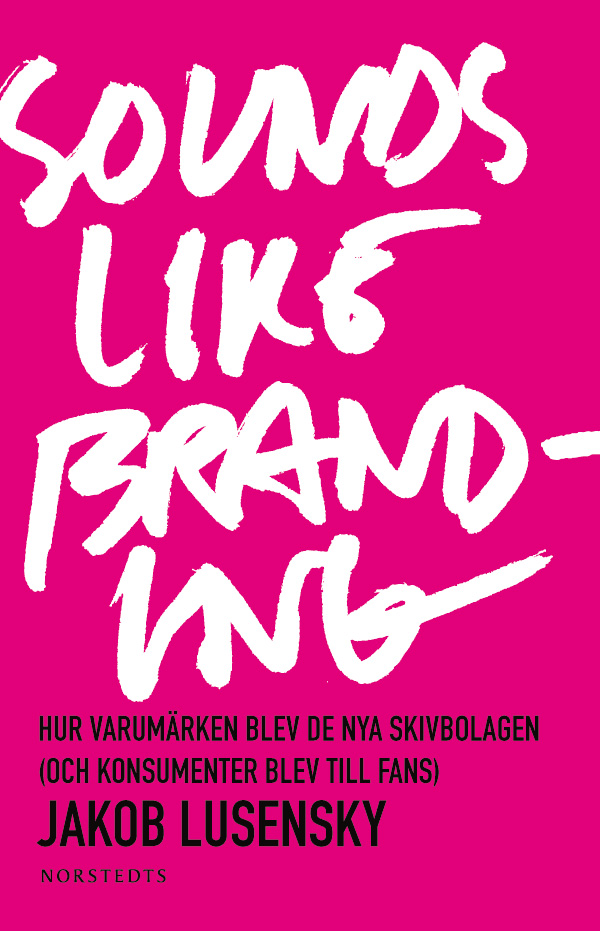 Sounds Like Branding the book is released in Scandinavia in February 2010. Written by Heartbeats International founder Jakob Lusensky, it’s the first in the field of music branding. It tells an exciting story about how brands became record labels and consumers turned into fans. It also presents the models and tools at hand to work with music branding in practice.