• Categories

  • Uncategorized

    Brands showcase a music and culture extravaganza at Coachella

    Although this year’s lineup didn’t match the likes of previous year’s according to many festival goers, Coachella still managed to sell out within a few days and draw a crowd of 70,000+.

    Produced by Goldenvoice (part of AEG Live), it was organized in the Empire Polo Fields in the Coachella Valley, idyllically surrounded by mountains and palm trees, a half-hour drive from Palm Springs and a few hours from Los Angeles. In scorching heat and on beautifully kept lawns, it must be the most vacation-like and tasteful looking festival in the world.

    Besides the immense lineup (more than 60 acts during three days), the festival also included an impressive display of huge art installations mainly pioneered by the Creators Project; an honorable contribution to Record Store Day with nearly the complete lineup (!) signing records at the ZIA Records Tent; and a chance to spot anyone from Los Angeles celebrity scene, whether it be Kirsten Dunst mingling at parties, Usher hanging out poolside or Danny DeVito singing and dancing (!!) backstage to Robyn’s performance.

    As for the brand perspective, Coachella’s location among vacation homes and chic hotels gave rise to numerous offsite-events; this being why Coachella has become just as much about what goes on outside the festival, as inside. Each day was packed with countless parties and most people went through the whole weekend without having to spend a dime. For the brands this meant competing about doing the best event, having the most notable guests, and booking the coolest talent. For some brands this meant hosting over-crowded parties of pumped up people nervously posing by a pool, and dishing out an abundance of (useless) free products, or, for others, trying to achieve the most excellent experience and perfect brand event, where the branding was subtle yet creative, and the production was so professional that anyone and everyone walked away as a huge brand ambassador.

    More specifically on how to get this right, this often meant teaming up with the right creative partner and to give them as much creative freedom as possible, as in the case of Adidas partnering with Jeremy Scott, The Ace Hotel and their collaborations with various labels and creatives, and the Stones Throw x Brainfeeder x Badu day party with DipDive and BlackBerry , which easily brought in better performers, unexpected guests and general good times than any of the two brands could have done on their own.

    jeremy-scott

    By Eric Welles Nyström, member of the Heartbeats Movement

    Print

    Tunecore CEO Jeff Price Responds: “When Artists Become The Product”

    Last week we published a post, “D.I.Y. Music - When Artists Become The Product” by William Gruger, first posted at Hypebot. The post questioned the value of the growing “online industry dedicated to earning money and exposure”. Tunecore CEO Jeff Price recently responded:

    The challenge with articles like this is they imply some sort of “magic wand” which, if waved, allows musicians to have instant fame and success. This is just not the case.

    The secret to success for a musician is in the art itself. If a snake oil salesman comes asking for money, promising, “Kid, I’m gonna make you a star”–it’s most likely utter bull. A case in point: 98% of what the major labels released and promoted failed. They spent billions of dollars over the years pushing music they hoped would cause reaction, and 98% of the time they failed and the artists still had to give up their rights ending up worse than when they started.

    Music needs to cause reaction. In other words, the thing that propelled Nirvana to superstardom was Nirvana’s music. If people didn’t react to the song “Smells Like Teen Spirit,” it wouldn’t have mattered how often they heard the song or seen the video: it was the song itself that caused the fame.Music needs to cause reaction. In other words, the thing that propelled Nirvana to superstardom was Nirvana’s music. If people didn’t react to the song “Smells Like Teen Spirit,” it wouldn’t have mattered how often they heard the song or seen the video: it was the song itself that caused the fame.
    tunecore

    Read the whole response by Jeff Price at Hypebot, here. Please, join the debate and let us know your opinion!

    Print

    D.I.Y. Music - When Artists Become The Product

    This article was first posted at Hypebot. The writer, William Gruger (@wgruger), brings up some bold questions and starts an important conversation. We don’t say that Gruger is right about everything he writes here.  Some of the things he says about  companies we highly respect are a bit controversial. But Gruger still highlights some major concerns worth giving an extra thought or two.

    It seems like there is an Internet outlet that allows individuals to be whoever you want to be.

    People who think they’re writers start blogs, photographers or fashionistas start Tumblrs, and people who think they’re film makers make YouTube accounts.

    For prospective musicians, however, there exists not just a smattering of sites, but an entire online industry dedicated to earning money and exposure.

    There has been endless press about how ReverbNation, TuneCore, SoundCloud, Kickstarter, etc., have innovated the landscape by crafting the tools to turn musicians into efficient and effective music businessmen, allowing everyday people to become full time musicians, or so it seems.

    social-media201104135

    However, this new type of exposure doesn’t necessarily lead to fans opening their wallets and, it certainly doesn’t mean it’s worth it for artists to invest any amount of money into online marketing.

    Anna Rose Beck, a folk singer/songwriter from North Carolina who first started with YouTube videos, was able to garner an audience and begin gigging in the area after heavily investing in a mix of these online tools. Her web efforts were effective in helping build an audience, but less so when it came to covering her first album’s production costs (the album is set to be released this April).

    Despite raising over $2,100 with a Kickstarter campaign, her Myspace and ReverbNation exposure failed to lift her out of the red.

    “Relatively nobody knows who I am, but if I’m going to start charging people online then absolutely nobody is ever going to know who I am.” she says.

    Devin Fry, a musician from Austin, Texas agrees. “You have to make convincing music, and lots of it, and talk about it, and give it away. If you’re a D.I.Y. musicmaker or bandleader and you’re worried about the lost revenue of someone downloading your songs for free, you’re ignoring the bigger picture.”

    Devin and his band Salesman play what Denver Thread describes as “What would’ve happened if Jeffrey Lee Pierce hadn’t died, and instead invested in a little voice coaching? Or – maybe a lot of voice coaching.”

    “I’m fed up with band self-starter programs, as you succinctly call them. Because they come at you trying to sell you shit you don’t need, promising to ‘increase your fan base,’” Fry says. “Insidiously enough, they’re targeting modest, broke, D.I.Y. musicmakers and bandleaders, people exactly like me.”

    Indeed, ReverbNation claims that a budding musician will accrue more fans with “an arsenal of free viral marketing tools for Myspace, Facebook, Twitter, blogs, and your homepage.” As if a broadened fan base weren’t enough, musicians can profit directly by using the Reverb Store to hawk “T-shirts, CDs, downloads, hats and ringtones directly to fans on Facebook, Myspace, Twitter, and your home page or blog.”

    The way these companies phrase their offerings sound completely absurd.

    TuneCore sports even loftier promises that you’ll be able to, “Join Nine Inch Nails, Drake, Keith Richard, Jay-Z and tens of thousands more musicians just like you to get heard, shared and discovered.”

    People are all aware of the marvelously positive impact digital distribution has had for tens of thousands of musicians trying to get their material out there. Never before have music consumers had a better chance to discover artists and niches of flavor that appeal the most, but also never has the amount of noise and clutter been so high. The idea that an internet tool will provide hopeful musicians with the same marketing power as these major label signed artists is extremely over-ambitious.

    “I’ve wasted my time creating Salesman accounts at ReverbNation, Myspace, TuneCore, iLike, etc,” continues Fry, “and I’ve learned that my promotions time is better spent outside flyering. Talking to people and setting meetings with people I want to work with.”
    salesman

    The bigger picture is gaining exposure, not trying to monetize every move with overcomplicated and cost ineffective online merchandise stores. While it may be true that “being a musician requires so much more motivation than it used to … motivation to be a self-promoter and an entrepreneur and to actually market for yourself” as Anna puts it, it doesn’t mean that musicians should buy into what are often lofty – and false – promises.

    “Baseline: it’s important for a band to have an online presence that looks and sounds the way you want it,” says Fry, “something that gives the flavor of what to expect at a live show. If your show is badass like it should be, you only need one such supplement.”

    And musicians can certainly supplement their online shows for free. Hell, the guys from Odd Future did it with just a Tumblr and YouTube, which are both free to use. Sure, D.I.Y. platforms can certainly increase a musician’s chances of being discovered, but on a mass scale, turning page views and video hits into sustainable income simply is not a reality.

    Are we simply spinning our wheels with trying to make an industry out of manufacturing musicians?

    Print

    Will a toy win the battle?

    Bands and labels continue to fight against piracy and the current downturn in the music industry. Some bands and labels come up with innovative and fun ideas in this war of theirs. One example being the Norwegian band Datarock. But is this the way?

    datarock_toy_mechanical

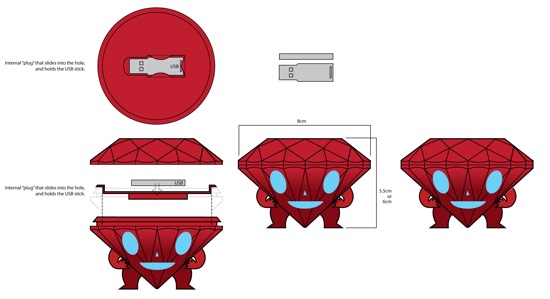
    When the indie-disco brothers Datarock released their latest single, they did it in the form of a designer ‘toy’ loaded with a great deal of extra media. The single comes in the shape of a 3 inch soft-vinyl red diamond figure, with arms, legs and a face, created in conjunction with Hybrid Design and Super 7. Concealed within the ‘toy’ is a tiny USB storage drive containing the latest single plus 105 bonus tracks, 1500 photos, 20 music videos, and a 60 minute concert film… But does anyone need this much of a band in their life?

    For existing (fanatic) fans of the band I guess the ‘toy’ might be a preferred way to get the new single. Then I think of ‘New-Kids-On-The-Block-kind-of-fanatic-fans’ (those of you who were there in the late 80s knows what I’m talking about). For the rest? I doubt it. Unfortunately.

    I don’t believe a ‘toy’ will battle the war against piracy and downturn in the music industry. However, it’s a fun and innovative idea, and there’s plenty of inspiration to be taken from bands and labels who try to do something new to survive in the music business!

    By: Sara Zaric

    Print

    Hip Hop artist London’s record label: Brands

    Interview Magazine gives us this interview with ‘hip hop’s newest name’ Theophilus London. London has been doing it the way we’ve talked about for a while, i.e. working with brands as the new record labels…

    bushmills-theophilus-london

    POLLOCK: When you say your brand relationships, you’re talking about Bushmills and Cole Haan?

    LONDON: Bushmills, Gucci, Cole Haan, Nike, Mountain Dew.

    POLLOCK: What’s it been like working with them and rising at the same time?

    LONDON: It’s such a new idea, because you’re supposed to rise first then all that shit comes. Like, “Oh this song is hot. Let’s put it in a commercial.” But I got these deals before I was a household name to the masses, not just to the progressive people that know me. It’s about the fucking people who are chilling in this pool right now. They get to know me because of a commercial or a billboard in New York City. It’s such a new idea. I’m building a new business model for artists who want to do this after me—artists that haven’t even put an album out yet. I put an EP and three mixtapes out. I didn’t know that was the path I was choosing. And I’m really cool with ladies, so if it’s a lady in charge of the brand, then, yeah, I’ll get the deal. You know, in a business way.

    Read the whole article here.

    Those of you who follow us regularly have probably seen the video of London spontaneously performing ‘The Brand Song’ backstage at SXSW. Those of you who haven’t, check it out.

    Print

    Sounds like Branding in paperback edition and more…

    slb-paperback2

    The Swedish version of Sounds like Branding has been reprinted in a paperback edition by Swedish publisher Norstedts, and is available for purchase here. Bloomsbury Publishing Plc (A&C Black Publishers Ltd) plan to publish the book in the UK on the 18th of July. The book will also be released in South Korea by Acorn Publishing this Autumn.

    For more info, subscribe to our latest news (up to the right), or just continue keeping an eye on this blog.

    Interested in the English beta version of the book? Subscribe here or download it here.

    Print

    Pepsi Refresh Project Challenges America to Rock the House for a Good Cause

    Yesterday, Pepsi launched the second year of its Pepsi Refresh Project, calling on people from across the US to submit ideas that have the power to move communities forward.

    The categories are EducationCommunities and Arts & Music, but in addition to these three, Pepsi will announce a new Pepsi Challenge each month. This month, Pepsi is challenging fans to channel their love of music to drive social change by asking, “How would you rock the house for a good cause?”

    Pepsi is enabling innovative ideas through the Pepsi Refresh Project, a platform for inspiration, learning and taking action. By awarding more than $1.2 million each month to ideas that receive the most votes at www.RefreshEverything.com, Pepsi aims to encourage ideas that capture the youthful optimism in all of us. Pepsi truly believe that every individual can refresh the world!

    Find more information at www.facebook.com/Pepsi, or on Twitter @Pepsi or #pepsirefresh.

    Via popsop.com

    Print

    SXSW 2011 Ups&Downs

    Eric Welles Nyström, member of the Heartbeats Movement and our man at this year’s SXSW, gives you the ‘ups&downs’ in regards to bands and brands performing at the much celebrated music conference in Austin, Texas.

    SXSW Brands Top Three

    • The ‘Fader Fort by Fiat’ and how they let Odd Future go totally ballistic onstage.
    • TDK and their new speakers series that combine 70s vintage design, 80s boombox concept and modern technology, to create the best product across the whole of SXSW.
    • AOL and their continuous well-thought-out and well-executed events.

    tdk2

     
    SXSW Brands Bottom Three

    • The ‘Fader Fort by Fiat’ and their lack of new ideas and creativity compared to previous years. Having bands play on car parts was the ultimate low.
    • Chevrolet, Camel and Marlboro and their lack of understanding on how to introduce their monster products into a creative music festival.
    • All brands, companies and labels who wasted their marketing budgets on download cards, scrapers, useless gimmicks and flyers that nine times out of ten, were thrown away by whoever received them.

    camel_malboro2

    SXSW Top Trends

    • Brooklyn’s dark electro/art music scene of gothic, witchlike sets and strong influences of 80s synth and old movie soundtracks, received wider recognition with a number of parties outside of Austin.
    • Esben & the Witch, Glasser, Friendly Fires and Millionyoung continue developing their style with tribal drums.
    • One common denominator among SXSW’s best dressing artists… hats! Including Totally Totally Enormous Extinct Dinasour’s remarkable dinosaur feathers, Theophilus London’s wool felt cowboy hat, Twin Shadow’s brown furr hat, and Night Jewels traditional Fez…

    weird_magic

     
    SXSW Most Symbolic Moments

    • Theophilus London’s freestyle rap backstage at the Fader Fort, where he made up the ‘The Brand Song’, in the most branded place in the country.
    • Hanson and their hustle throughout the whole city. One day you would see their new album plastered across major billboards, and the next day you would find them in the audience of panels and hustling keyboard speakers for industry insight and feedback.
    • As the Saturday night came rolling in and local new media stated that it was the largest full moon in Austin for more than ten years, everyone from Jay-Z, Jamie XX and James Blake, along with countless other major artists (Kanye West, LL Cool, P. Diddy to name a few) and a couple of hundred other bands played free shows throughout the city.

     
    SXSW Most exciting projects for 2011-2012

    • iTunes project with Green Label Sound
    • Converse’s new recording studio in Brooklyn, Rubber Tracks
    • Vice’s concert recording site Noisey.com

     
    SXSW Top Band Performances

    • Glasser at the Central Presbyterian Church
    • Braids and the fact they don’t have an album yet
    • Gayngs and their 20+ people onstage performance
    Print